

Exclusive Interview with Notorious Skyjacker Martin McNally
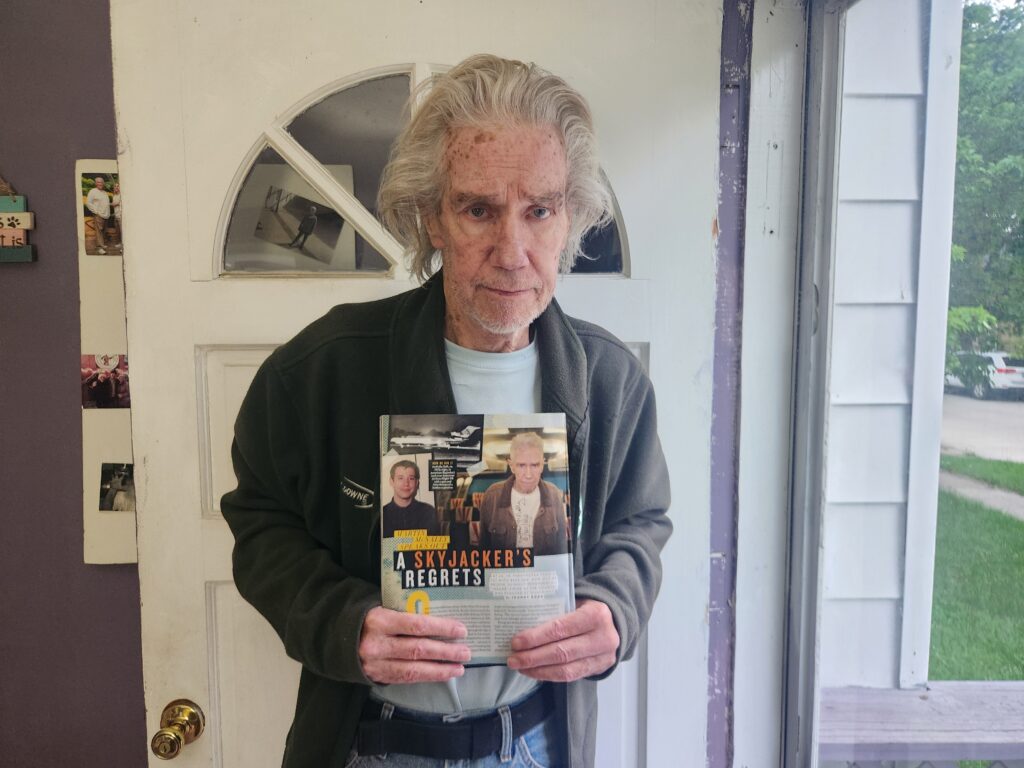
How D.B. Cooper’s Most Daring Copycat Survived a 320-MPH Jump from a Boeing 727, Lost the Money, Spent 37 Years in Federal Prison, and Came Home to Michigan
By: Ryan M. Place
Martin McNally lives quietly now. That’s the first strange thing.
After all the noise, after the engines, the ransom, the submachine gun, the screaming wind beneath the rear stairs of a Boeing 727, the FBI manhunt, the life sentences, the helicopter escape attempt, the control unit, the parole board, the duffel bag, the halfway house, the documentaries, the myth, the regret, the decades buried alive screaming in the endless void of the federal prison system, Martin McNally is now an octogenarian in Melvindale, Michigan.
He is eighty-two years old. A former Catholic school kid from Wyandotte. Navy veteran, son, brother, criminal, survivor. A witness to one of the strangest and most violent eras of skyjacker cloning in American history. He features prominently in the book, The Hijacking of American Flight 119.
Table of Contents
READER ADVISORY
This article contains graphic depictions of violence, prison, and homicide. Reader discretion is advised.
Introduction
Some fifty-four years ago, on June 23, 1972, Martin McNally hijacked American Airlines Flight 119 from St. Louis to Tulsa. He boarded under the name Robert Wilson. He was carrying a $30 wig, rubber gloves, a .45 caliber submachine gun, and a plan inspired by skyjacker D.B. Cooper. Showing zero regard for human life, he skyjacked a plane and coldly demanded $502,500, parachutes, a collapsible shovel, and a way out.
Then, in the dark, over Peru, Indiana, with no real parachuting experience, he stepped onto the aft stairs of a Boeing 727 and leapt into the darkness carrying more than half a million dollars in ransom.
The Boeing 727 was traveling roughly 320 miles per hour. Civilian skydivers almost never jump from aircraft moving anywhere near that speed, much less at night, with a heavy load, over unfamiliar terrain. Every variable was working against him. When he let go, there was a split second of weightlessness and near silence. He was falling peacefully. Then the roar of high-speed wind, the relentless pull of gravity, spun him thru the darkness.
Most people would have died. Improbably, McNally lived.
But the fantasy evaporated when the bag of money detached from his body. Five days later, the FBI arrested him at his house in Wyandotte, Michigan. He would spend the next nearly four decades in federal prison.
“I sold my entire life for going after half a million dollars,” he told me. “My future was gone. Poof! Like that.”
Wyandotte, Before the Fall
Before he became one of the most famous skyjackers in American history, Martin Joseph McNally was a regular civilian in Southeast Michigan.
He was born March 16, 1944, in Trenton, Michigan. His father was from Scranton, Pennsylvania. His mother was from Wyandotte. His father, Walter, ran McNally Shoes. Years later, Martin’s sister Claire would buy the McNally Shoes location on Park Avenue in Allen Park. She also owns the strudel shop on Park Avenue.
McNally was the third of eight children. He had an older brother, an older sister, then came Marty, then the rest.
Initially, the family lived near Biddle and Northline, across from the old cemetery. In 1952, when Martin was in third grade, they moved to 2019 Davis Street at 21st Street in Wyandotte.
He grew up Catholic. He was a good singer. He attended St. Patrick’s High School in Wyandotte until one fateful day.
On the first day of eleventh grade in 1961, according to McNally, a nun bluntly informed him that he had failed religion and would have to retake tenth grade religion.
“The fucking bitch failed me,” he said. “I was so mad, I wanted to smash her fat penguin face in.”
The classroom was on the third floor. McNally walked out, flipped off the classroom, went down to the principal’s office, got the number for the Navy recruiter from the phone operator, and called.
“I’m seventeen,” he told them. “My brother Pat is in the Navy. I want to join right now.”
He went home. His father tried talking him into switching schools, maybe Roosevelt High School. But Marty’s stubborn mind was made up.
“Going into the Navy was the best decision I ever made,” he said. “Here I am, I have a pension, full medical benefits.”
From 1961 to 1964, he served in the U.S. Navy, including time at Great Lakes Naval Station and in an aviation squadron. The Navy gave him benefits, identity, structure. But after the Navy, it was the beginning of a long fall.
McNally was restless. Curious. Adventurous. He wanted money.
On August 27, 1966, he broke into Cook’s Sportland in Monroe. There were other break-ins. In 1969 or 1970, he met with Joe Louisell, the famous Detroit Mafia criminal attorney, for advice on how to skirt the law.
He also had scams. One involved copper slugs.
He had a device that could make fake quarters. He would go to Detroit, get copper sheets, turn three sheets into about $500 worth of copper slugs, then go to laundromats, drop them into machines, and get money back.
It was small-time crime. Then D.B. Cooper upped the ante.
The Ghost of D.B. Cooper
In November 1971, a man calling himself Dan Cooper boarded a Northwest Orient flight in Portland, Oregon, demanded $200,000 and parachutes, then jumped from the rear stairs of a Boeing 727 into the night and vanished.
A newspaper mistake turned him into D.B. Cooper.
The name stuck. To this day, the man’s real identity has never been discovered.
The myth exploded immediately across the popular consciousness.
McNally remembered exactly when he heard about it. He was driving down Southfield Road toward Plymouth Road. It was around 10 a.m. The radio was talking about aircraft piracy and D.B. Cooper.
“I laughed like hell,” McNally said. “I thought, that’s a helluva way to make a score! Extortion note. Ticket. Weapons. Plane. Parachute. Money. Bam! Then you vanish, like a ghost.”
To McNally, it seemed not only possible but achievable. He was caught in the gravitational pull of a dangerous fantasy. That tenuous line between fantasy and reality blurred and he got sucked in.
Yet, America in the early 1970s made it possible. This was the golden age of hijacking, when commercial aviation still carried some of the old glamour and almost none of the modern security. People could walk right onto planes on the tarmac with little scrutiny. Between 1961 and 1973, roughly 150 commercial planes were hijacked. In 1972 alone, there were about fifteen D.B. Cooper copycats.
McNally became one of them.
Before the hijacking, he was working at a Shell gas station at Five Mile and Beech Daly in Redford with his business associate Jim Petty.
He had “too many idiot friends,” he says now. One of them, Walter Petlikowsky of Ecorse, gave him the submachine gun. McNally bought the wig for $30 on Telegraph Road.
Looking back, he does not romanticize the plan.
“My heist was stupid, insane, I should’ve known better,” he said. “It was a ridiculous stunt.”
But in June 1972, he still believed he could do it.
American Flight 119
On June 23, 1972, Martin McNally boarded American Airlines Flight 119 in St. Louis.
He was twenty-eight years old.
The flight was headed to Tulsa. There were about 94 people aboard. McNally carried a submachine gun and notes. He had modeled the crime on D.B. Cooper, but he wanted more money. Cooper had asked for $200,000. McNally demanded $502,500.
He forced the plane back to St. Louis.
The scene quickly became tense and surreal. The airline frantically gathered the money. Authorities scrambled. Then, as the plane was readying for takeoff, one of the strangest details in American crime history unfolded: a man who had been drinking at a local bar and heard the story on the radio, hopped in his Cadillac Eldorado, drove thru an airport fence and rammed the landing gear in an attempt to stop the hijacking, damaging the plane and forcing everyone to change aircraft.
McNally was eventually given the money and parachutes.
But there was something wrong with the parachutes.
“They brought those reserve parachutes onboard,” McNally told me. “Sharon the stewardess said she knew they were trying to kill me.”
Reserve chutes were not what he needed for a safe jump from a commercial jet going 320 MPH. But by then, the machinery of the crime was already moving. The plane was in the air. The engines roared. The aft stairs wobbled open into darkness.
McNally had half a million dollars in cash.
A collapsible shovel.
A parachute.
An ever-intensifying fantasy.
Then he jumped.
The Boeing 727 was moving around 320 miles per hour. Normal parachutists often jump at roughly 90 to 115 miles per hour. McNally was thrown into the night with terrible force.
Somehow, he survived.
But the money did not stay strapped to his body.
The bag tore away and disappeared into the dark Indiana farmland below.
A soybean farmer later saw an American Airlines bag. His grandson recognized what it might be.
“This is the money they gave that skyjacker!” the grandson said.
By then, the story was worldwide news.
McNally had pulled off the impossible part. He had hijacked the jet. He had gotten the ransom. He had jumped from the 727 and lived.
But without the money, the plan was a failure.
His next plan, he says now, was to immediately get another disguise, find another airport, and do it all over again.
Fortunately, he never got the chance.
Arrested in Wyandotte
Five days after the hijacking, McNally was arrested at his house at 4682 16th Street in Wyandotte.
The FBI took him to its office in downtown Detroit. The next day, Barbara Walters was talking about it on television.
He was charged with federal aircraft piracy. He tried to delay the trial by filing a motion for a competency evaluation. His trial took place in St. Louis in December 1972. He was convicted.
In May 1973, he received two life sentences.
He was twenty-nine years old.
The judge’s gavel came down. In the shockwaves of that thud, McNally’s life changed forever.
Springfield: The Beating That Changed Him
On September 11, 1972, before sentencing, McNally was at the federal medical center in Springfield, Missouri. He remembers the exact cell: 2-1-East, cell 4. He remembers the time: 9 a.m.
He had showered. A guard pushed him into the cell. Angered, McNally spit on the officer.
Later that day, two guards came into his cell and “beat the living fuck outta me,” he said.
“I tore up my mattress, sheets, clothing, everything, I was enraged,” McNally said.
The next morning, medical staff came around the way they did every morning. They saw him, said nothing, and left without examining him.
“That experience changed how I did my time,” he said. “I thought, I’m gonna get revenge on this.”
Prison hardened him. Not slowly. Immediately.
He entered the federal system as a skyjacker. He twisted into something else inside.
Leavenworth, Marion, Atlanta, Terre Haute, Atwater
McNally did time in a string of serious federal prisons: Leavenworth, Atlanta, Marion, Terre Haute, and Atwater.
He spent nineteen years at Marion, his longest stretch anywhere, inside one of the USA’s most violent federal prisons.
USP Marion, Illinois, was the end of the line for inmates considered too dangerous, too disruptive, too uncontrollable. It was a psychological pressure cooker of searing racial tension, profound isolation, grisly stabbings, and killings.
McNally remembers 350 men in the compound.
He remembers the furrowed indentations of human fingernails on the walls.
He remembers the welding shop.
In July 1973, he was working in CMS Welding. A man said they needed 40-50 weapons. They stamped blanks out of stainless steel sheets. The weapons were passed to A Block, B Block, D Block.
On July 31, 1973, a riot broke out. A guard was killed in A Block. McNally was in B Block when it happened during lunch.
In September 1974, a friend of his named Gypsy (Willie Adams) killed a guard in B Block, stabbing him more than 100 times with a fourteen-inch, sixteen-gauge stainless steel custom shiv McNally says were made in the welding shop. Gypsy later ended up in the Marion control unit and hanged himself.
In 1975, McNally was charged with attacking a guard and cutting up his face. He beat the case on September 18, 1975, in federal court in Topeka, Kansas.
“The jury deliberated five minutes,” he said. “Not guilty.”
Reading His Way to Freedom
Prison did not only make McNally violent. It made him educated.
He read voluminous stacks of thick law books packed with dense, impenetrable legal jargon. Akin to a foreign language, it’s something very few people outside the legal profession ever truly master.
“I wanted to understand the system, the cemetery where I was buried alive,” he said. “And find a way to tunnel out. And I did.”
Through his legal work, he says, he reversed four life sentences: two of his own and two belonging to Garrett Trapnell.
He wrote a forty-nine-page brief with a thirty-page appendix. He says it changed the law nationwide on the issue of prejudicial pretrial publicity.
He also wrote an article called “My Time, Your Time,” a four-page piece. One of his good friends was Jack Henry Abbott, who worked with Norman Mailer on the book In the Belly of the Beast.
McNally has advice for new inmates: Get an education. Stay clean. Don’t do drugs.
Garrett Trapnell
Garrett Trapnell was one of the most notorious conmen and hijackers of the era.
McNally called him Trap.
“Garrett Trapnell was a genius intellect and an absolute grand master manipulator,” McNally said. “He also had five wives simultaneously.”
Trapnell arrived at Marion from Leavenworth before McNally. At first, McNally wanted to kill him.
“I told my sister I’m going to kill him on sight for what he did to those college students,” he said.
But he held off. Trapnell lived two or three cells away.
In January 1978, Trapnell knocked on McNally’s cell.
“Mac,” Trap said.
“What’s up, Trap?”
Trapnell looked around, then looked at McNally. “How’d you like to get out of here?”
The next day, they talked out on the yard. Trapnell said a girl named Barbara Oswald in St. Louis had started writing him. The escape plan involved her hijacking a helicopter. McNally noticed the prison was building a new guard tower.
“Trap,” he said, “this sounds good but we gotta speed up the timeline on the helicopter.”
The Helicopter Disaster
May 23, 1978.
McNally had warned Trapnell that Barbara could not come to Marion on the same day of the escape. But she did.
That afternoon, after the noon meal, Trapnell came to McNally’s cell.
“Are you ready?” he said. “It’s on tonight.”
At 4 p.m., the prison did count. Chow was at 4:30. McNally walked down the corridor. At 5:30, the yard was not open. McNally told Trapnell and Kenny Johnson it was closed.
At 5:45, he went into the corridor and suddenly the door was open.
They went to the yard.
At 6 p.m., they heard the whirring of the helicopter overhead.
McNally waved triumphantly like a man being rescued from a deserted island.
The helicopter landed.
Then everything went wrong.
Barbara Oswald had hijacked a helicopter at gunpoint. The pilot, Alan Barklage, was a Vietnam Veteran and unfazed.
At around 2,000 feet, Barklage distracted her, saying the door was hard to open. Then he grabbed her gun, a .44 caliber, blew a hole in the door. She dove into her purse for her other gun, so he fired four shots: two into her skull, two into her chest.
The autopsy said there were 1100 cc’s of blood in her chest cavity.
When the helicopter landed at Marion, Barklage got out frantically signaling the guard tower.
Trapnell went catatonic and slowly sat down.
McNally ran for the building with Kenny Johnson. They were on the main roof, preparing to go down into the main yard, when they looked over and saw a guard about 250 feet away, calmly waving for them to come over.
They were cuffed and taken to segregation.
Later, Trapnell came and told them Barbara had been killed.
“Total disaster,” McNally said. “The little fingernail sliver of hope I had left in me about myself, about freedom, about everything really, died that day.”
Looking back, he does not excuse it.
“We were monsters,” he said. “Me and Trap and Kenny.”
On July 12, 1978, McNally was placed in the control unit. Being in a control unit meant being locked in a single cell 22-23 hours per day. He spent four years there.
The Control Unit
The Marion control unit was no joke. McNally vividly recalls the stabbings and killings.
He remembers Steamboat (Charles Stewart), a thirty-three-year-old prisoner from Leavenworth who McNally said “had raped guys in Building 63.”
“It took us eight months to set him up for a hit,” McNally said.
On October 1, 1979, at 8:10 a.m., while Stewart was getting ready for outside recreation, Clay (Clayton Fountain) and Baby Huey (Larry Cologne) killed him.
McNally watched it unfold.
“The shiv made snapping sounds in his skull,” he said. “Blood came gushing out of his nose and mouth.”
In 1982, the Aryan Brotherhood killed Cadillac Smith at Marion. McNally remembers “Terrible” Tommy Silverstein and Clay Fountain being involved. He remembers two months of throwing letters inside tennis balls over a building into H-rec yard.
They discovered they could meticulously pack 150 double-edge razor blades into a single tennis ball.
He explains how razor blades are high-carbon steel and could cut low-carbon beds. They’d get electricity from outlets and melt a blade onto a toothbrush, using it as a cutter.
He also worked in the paint shop.
“They actually wanted me to paint this torture chamber,” he said. “Can you believe it?”
Famous Prisoners
Over the years, McNally met several notorious inmates.
Ramon Matta, the Honduran trafficker, was doing four life sentences. McNally says Matta was a billionaire who owned 17,000 acres in Tegucigalpa, Honduras. McNally helped him.
Carlos Lehder was at Marion. He was a Medellín Cartel drug trafficker with Pablo Escobar.
Jack Henry Abbott was his friend.
Garrett Trapnell was his co-defendant, his collaborator, and fellow walking catastrophe.
Somehow, McNally outlived many of them.
Leaving Marion
On July 31, 1997, McNally left Marion and was transferred to USP Atlanta.
By then, he had already spent decades inside. The world outside had moved on without him.
His father had died in 1977. His mother died in 1994.
His old Michigan life was disappearing person by person, business by business, memory by memory.
He still had family. He still had his baby sister, Claire. He still had faint memories of Wyandotte, McNally Shoes, Biddle Avenue, St. Patrick’s, the Navy recruiter, the old cemetery. But those memories grew dimmer with each passing year.
The country he had left in 1972 no longer existed. A strange new world had crept over everything like a futuristic fungi.
McNally lingered in various prisons for another 10+ years until one day.
Parole
Wildly, unexpectedly, on July 18, 2009, someone told him: “Mac, you’re on the call-out for parole hearing in the morning.”
“I thought goddamn that’s a cruel joke because I had waived my parole, I wrote a letter and everything.”
Sure enough, he saw his name on the bulletin board for a 9:30 a.m. call-out. They had missed his letter.
Suddenly, he’s in a small room talking to a man some 2,800 miles away in Chevy Chase, Maryland on a computer screen who tells him, “I’m going to recommend you for release on parole.”
McNally was an original jurisdiction case. Twelve examiners had to review his case because there were about 2,000 federal inmates eligible for parole.
On January 27, 2010, Martin McNally was paroled from USP Atwater.
“To say I was excited was an understatement,” he said. “I was enraptured to the point that it didn’t feel real, it felt like I was stepping out of the literal depths of hell into some wonderful dream.”
He had 100 pounds of property in a big duffel bag.
At first, he wanted to go to Las Vegas. He asked if he was on the no-fly list. On a bus from California to Vegas, he called the airport and told them he had convictions for aircraft piracy. Surprisingly, he could still fly. “Unfreakingbelievale, I thought,” he said.
It took three days to get from Atwater to St. Louis.
On January 29, 2010, he entered a halfway house in St. Louis.
He left May 6th.
Getting out was a shock. It took a while to adjust to civilian life.
At a gas station, he paid $1 for a piece of candy that he remembered costing a nickel.
After nearly forty years inside, even candy had become evidence of time travel.
Freedom
In 2016, parole officers came to his apartment in St. Louis with his friend, local reporter, Danny Wicentowski.
“Mac, good news,” they said. “You’re off parole.”
He was free in a way he had not been free since before the hijacking.
Free, but carrying Marion, Leavenworth, Atlanta, Atwater, Springfield, the helicopter, the jump, the lost money, the dead bodies, the guards, the law books, the duffel bag, the ghost of the young man who laughed about D.B. Cooper.
American Skyjacker
In 2014, McNally was cruising the internet. He commented online about Canadian prisons learning lessons from the American federal prison model. Danny Wicentowski messaged him and said he wanted to talk.
Danny was a 24-year-old St. Louis reporter at the time. He came to McNally’s St. Louis apartment. They discussed McNally’s case and life story.
McNally gave him the rights to his story.
Danny eventually accumulated a huge archive, including about 100 pounds of McNally’s documents.
In January 2017, Danny published his article in the St. Louis Riverfront Times.
Filmmakers Eli Kooris and Josh Shaffer read it and contacted Danny. They filmed McNally in 2018 and 2019 as an independent film project.
The result was American Skyjacker, the 2025 hit documentary about McNally’s life and crime.
There had also been other media interest. In 2016, Gary Jenkins, a lawyer and retired ex-cop who runs Gangland Wire, asked if he could film him. McNally said sure.
The story had become too bizarre not to follow.
Coming Home to Michigan
In November 2019, McNally moved from St. Louis to Melvindale, Michigan.
He was being evicted from his four-apartment building because the landlord had sold it. He looked into housing in Michigan and found a $33,000 place in Lincoln Park, but with taxes and utilities, he still needed something cheaper.
His sister Claire had a property in Melvindale.
So he came home.
Melvindale is about 15 minutes north of Wyandotte, where he used to live.
Close enough to feel the old map, walking down Biddle Avenue. Close enough to remember a simpler time before his identity became skyjacker and ex-con.
Violence, Regret, and the Line He Crossed
When I asked him about the hijacking itself, McNally did not feign innocence or say he was harmless.
During the hijacking, he said, he was not going to initiate the violence. But he was prepared to kill everyone who got in his way, if he needed to.
That sentence lands heavily. It should. It cuts through the myth. It prevents the story from becoming too stylish, too cinematic, too easy.
There were people on that plane. Stewardesses. Passengers. Pilots. Families. Innocent people who had no idea that a deranged man with a gun and a fantasy had decided to turn their flight into his escape plan.
McNally wanted the half million dollars to invest in businesses.
He imagined a future.
Instead, he traded freedom for a lifetime in prison.
“I sold my entire life for going after half a million dollars.”
There is no redemption arc here. No clean neat ‘everything gets wrapped up nicely’ Hollywood ending. McNally’s crime set in motion a lifetime of suffering. For himself, for the passengers he terrorized, and for countless others whose lives were touched by his choices.
If you had been on that plane, would you forgive Martin McNally?
The Long Road Home
The strange thing about sitting with Martin McNally isn’t that he once hijacked a plane. It’s that he’s still somehow here.
He is here after the jump.
Here after the FBI.
Here after the multiple life sentences.
Here after Marion.
Here after Trapnell.
Here after Barbara Oswald.
Here after the control unit.
Here after Atwater.
Here after the halfway house, parole.
Here after the documentary cameras.
Here in Melvindale, Michigan, telling the story in the same state where it all began.
A boy from Wyandotte leapt from a Boeing 727 into the dark.
An inmate spent decades in the belly of the beast.
Improbably, an old man came home.
Seduced by the myth of easy money, Martin McNally traded brief exhilaration for years of confinement. Instead of the ransom, he became inmate # 20400-175. In the end, the greatest price McNally paid wasn’t in dollars but in decades of unrecoverable, irreplaceable lost time.
Martin McNally fell from the sky.
Somehow, he lived long enough to explain what the fall cost him. And in many ways, he never stopped falling.
Ryan M. Place is a Michigan writer and entrepreneur. He is the founder of the Detroit Festival of Books (Detroit Bookfest), Michigan’s largest book festival, and Detroit Vinylfest, an annual music and record festival, both held at Detroit’s historic Eastern Market. Linkedin profile.